
Why your boots only last one winter
J.P. HenriYou know the story by heart.
Autumn is coming. You go into a department store, you see a pair of "trendy" boots for $150. They're beautiful, they're shiny. You buy them.
You wear them all winter. But by March, something's wrong. The sole starts to peel away on the side. The "leather" cracks at the toes. Water seeps in.
The following winter? They're only fit for the bin. And you go back to buy another pair.
At Gerry 1958, as shoemakers, we see the inside of those boots every day on our workbench. We know exactly why they don't last. And today, we're going to explain the difference between a wasteful expense and a lasting investment.
The culprit #1: Glue vs. Sewing
The main reason why a cheap boot dies quickly is invisible to the naked eye: it's the construction .
90% of fashion boots use a "cemented" (glued) construction. The upper (the top of the boot) is simply glued to the sole with industrial-strength adhesive. With Quebec's cold and humid climate, this adhesive inevitably dries out and fails.
The expert's solution: Goodyear welt construction
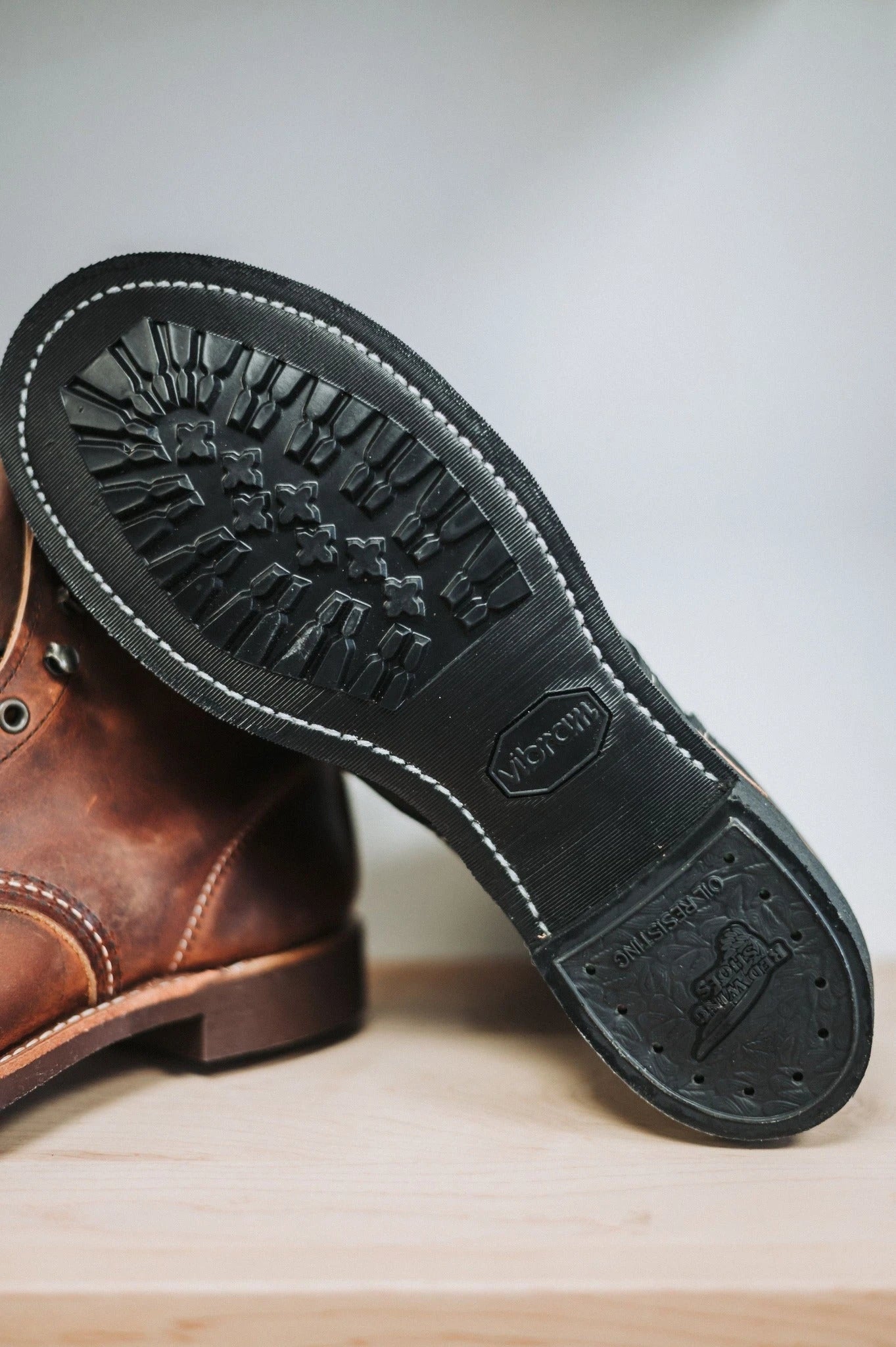
The boots we select (like the Red Wing Heritage ) use a centuries-old technique. The boot is stitched to a strip of leather (the welt), which is itself stitched to the sole.

Why is it better? It's a mechanical barrier against water. And most importantly, when the sole wears out after 5 or 10 years, we can replace it in our workshop . A stitched boot is practically indestructible if properly cared for.
Culprit #2: "Genuine Leather" vs. "Full Grain Leather"
Don't be fooled by the "Genuine Leather" label. It's often just the bottom layer of hide, sanded and painted to look like fine leather. It's thin and it cracks.
Full Grain Leather , which you find on our Iron Ranger or Moc Toe models, is the densest part of the hide:
- It doesn't crack, it softens.
- It doesn't age, it acquires a "patina" (it becomes more beautiful with time).
- It resists scratches and is easily repaired with a little oil.
Mathematical Calculation (The Price Argument)
This is where it hurts the wallet, but not in the way you think.
- Scenario A (The disposable boot): One pair at $150 each year for 10 years = $1,500 .
- Scenario B (Gerry's Boot): A pair of Red Wing boots at $450, resoled twice in 10 years = Approximately $750 .
Not only do you save money in the long run, but you also walk around in a boot that is both stylish and comfortable.
How to recognize a good boot? (The Shoemaker's Checklist)
- The Weight Test: A quality boot is heavy. It contains steel (shank) for support.
- Look at the stitching: Do you see any threads under the sole? If the sole is completely smooth, it's probably glued.
- Origin: Boots made in Canada or the USA meet much higher quality standards.
The last word
Buying boots is like buying tires. They're your only contact with the ground.
At Chez Gerry 1958 , we're not just salespeople. We're the ones who repair. That's why we only sell what we're not ashamed to fix.
DISCOVER OUR SUSTAINABLE BOOTS
Need advice on sizing? Contact the workshop or come see us on Demontigny Street.